Dog
Kay ScarpettaDogs occupy an unusually charged place in the novel: they are beloved companions, objects of mourning, indicators of character, and victims whose abuse links a pet-shop network to the wider machinery of human violence. Their presence turns apparently domestic details—hair on a rug, a puppy in a towel-lined basket, barking behind a basement door—into evidence of attachment and crime.
Companions, Grief, and Moral Attachment
Shrew’s apartment records her devotion to dogs even when no dog is currently living there. She keeps porcelain and crystal dog figurines, photographs of herself and her husband with the dogs they once shared, and a rug still marked by white and black hairs. She says that she loves dogs more than her children, and describes their hair as something that enters the heart as insistently as it enters fabric. In her account, dogs are not merely animals: they are fallen angels, while cats are visitors to the human world. Her bourbon-loosened speech is extravagant, but its emotional premise is firm. Dogs possess a moral importance that human beings repeatedly fail to acknowledge.
That attachment is concentrated in Ivy, a Boston terrier who died of parvovirus around Thanksgiving. Shrew did not originally buy Ivy from Puppingham Palace. A woman across the street received the puppy as a gift, could not keep her, and gave her to Shrew in panic. When Shrew first saw the animal, Ivy was no larger than a small flashlight and lay so still that she seemed dead. The sick puppy moved only after Shrew lifted her and held her against her body, pressing her muzzle into Shrew’s neck. Shrew named her Ivy because the puppy clung to her like climbing ivy. Ivy’s death therefore becomes more than a complaint about a bad purchase: it is the loss of a creature whose final bond was formed through rescue and physical dependence.
Dogs as Security and Vulnerability
Shrew also imagines the dog as protection against human danger. She considers obtaining another puppy from Hartendiefjes because barking and growling might deter burglars, while acknowledging that taking a dog outside could expose both owner and animal to assault, coercion, or theft. Her experience with an earlier Yorkshire terrier supplies a practical version of this fantasy. The small dog could be trained to use a litter box, lifted with one hand, and still bark loudly and bite ankles; it had to be carried in elevators and around visitors until it became accustomed to them. Ivy, by contrast, was too young and ill to walk on contaminated sidewalks. The dog is thus both a guard against intrusion and a dependent body that requires the owner to manage the dangers of the city.
This contradiction becomes sharper in Lucy’s care of Jet Ranger, an old bulldog who is nearly deaf, walks with a limp, and has trouble with house-training. He is poorly adapted to New York’s concrete and asphalt, especially after someone scatters red pepper around the few patches of soil and grass near the trees. When Jet Ranger inhales the pepper, Lucy concludes that a nearby shoemaker is responsible. She retaliates by spreading two kilograms of ground red pepper through the shop, including a large portion in the urine-smelling office, and anonymously reports the shoemaker to animal protection authorities. Her response is excessive and comic, but it also shows how the vulnerability of a dog can mobilize a forceful human defense.
The Pet-Store Chain and the Animal-Commerce Network
The novel contrasts the imagined standards of Hartendiefjes with the conditions Shrew encounters in its Lexington Avenue store. Her earlier research describes a clean chain staffed by people in white coats who provide nutritious food, medical care, and affection. The shops remain open from ten in the morning until nine at night, seven days a week, so puppies are not left alone for too long. Heating and air-conditioning are not switched off overnight to save money, and music is played to keep the young animals company. After Ivy’s death, Shrew has learned that drinking enough, staying warm, and avoiding isolation are essential to a puppy’s survival.
The actual store contradicts that reassuring description. Its window is dirty and filled with newspaper scraps; a plastic red fire hydrant leans precariously inside; no puppy is visible; and a sign says the store is closed even though the lights are on. A black Cadillac waits outside with its engine running. Inside, puppies bark, kittens sleep on wood shavings, and fish move slowly through aquariums. Behind the counter, cages rise almost to a water-stained ceiling. Shrew tries not to make eye contact because she knows that pity might compel her to take home an animal she had not intended to choose. Her hesitation reveals the commercial structure’s emotional trap: the creatures are displayed as merchandise, yet their visible vulnerability makes them impossible for her to regard as mere goods.
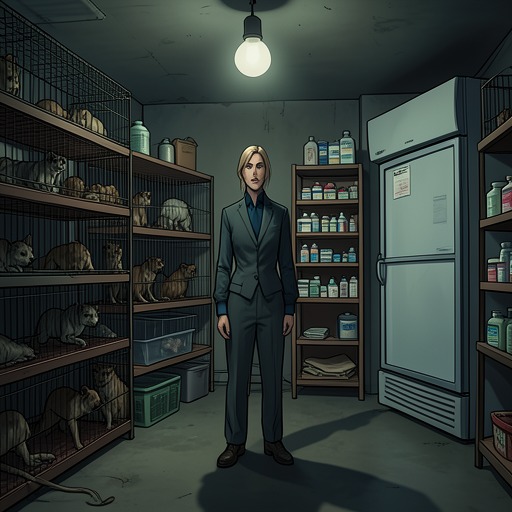
The basement destroys the chain’s public image. Shrew finds a dim storage room that smells of disease, excrement, and urine, with dirty paper in the cages. On a wooden table lie glass tubes, injection needles, red hazardous-waste bags, and heavy black rubber gloves. Beyond it, an open freezer contains the setting for a concealed operation. A man in a dark suit and black cowboy hat and a woman in a long gray coat stand with their backs to Shrew; when the woman notices her, she runs, while a heavy voice orders Shrew to stop. The dogs’ barking, initially the sound of possible pets for sale, becomes an alarm from a place where animals are being medically handled, confined, and treated as disposable material.
From Animal Cruelty to Human Violence
The pet-store abuse case identifies Jake Loudin as the owner of the store network and connects the animal trade to the novel’s criminal investigation. After a raid on one of his Bronx stores, Loudin was charged with eight counts of aggravated cruelty to animals, but the charges were withdrawn in December. The eight dead animals found in a freezer could not be proved to have been placed there alive, and the prosecution could not establish that the police had adequately demonstrated the absence of justification for euthanizing the eight puppies, each between three and six months old. The legal failure does not erase the image of the freezer; instead, it exposes how difficult it is to convert the material facts of animal suffering into prosecutable human responsibility.
Dr. Elizabeth Stuart provides another link in the chain. She recalls a little-known worker associated with both her veterinary practices and a pet store, someone who had given puppies to members of her staff and apparently helped care for animals. He once offered Stuart a puppy for her birthday: a deformed-looking Chinese dog with hair only on its head, tail, and legs, which was about one or two months old, trembling and coughing. The accompanying card made a bizarre joke about Stuart telling people that she also removed dogs’ hair and was a canine dermatologist. She rejected the gift and returned the puppy, but when asked what happened afterward, she answers that she can guess. The incident suggests a circulation of sick bodies through professional, commercial, and personal channels in which the language of gifts conceals exploitation.
That network ultimately converges with Mike Morales, who may have operated under the name Juan Amate in pet-store basements and been paid to add another portion of misery to the world. Berger’s reconstruction proposes that Loudin might admit Morales called him after Eva Peebles entered the basement at the wrong time and became a disruptive witness. The animal-cruelty system is therefore not a detached subplot. It offers Morales a setting, a supply chain, and a method for disposing of living beings, while the same indifference to vulnerability extends from puppies that cannot be sold to human beings whom he tortures and kills.
Narrative and Ethical Significance
Dogs give the investigation an emotional scale that forensic clues alone cannot provide. Shrew’s grief over Ivy explains why a dead puppy prompts another emergency call and why the pet-store case remains urgent even amid the murder inquiry. The barking animals, the contaminated cages, and the freezer make suffering audible, visible, and materially specific before the full human conspiracy is understood. Their bodies also challenge the distinction between sentimental domestic life and organized crime: a puppy received as a present, a dog used as a burglar deterrent, and an animal killed as unwanted inventory all belong to the same economy of value.
The novel does not treat dogs only as symbols for human innocence. They have distinct bodily needs—warmth, water, clean ground, medical care, company, and protection from disease—and those needs determine the actions of the people around them. Yet the narrative also shows how humans use dogs to express grief, justify retaliation, manufacture gifts, make money, and conceal violence. Dogs consequently stand at the boundary between independent living beings and objects shaped by human desire. Their suffering reveals that the crimes under investigation are not isolated acts of cruelty but part of a broader moral failure: the conversion of vulnerable life into merchandise, evidence, or waste.